Which of the following reactions is (are) feasible?
I Br (1) + 2CI 2(aq) 2Br (aq) + CI 2(g)
Ll 21 (aq) + Br 2(1) 2Br (aq) + 1 2(s)
Lll 2F (aq) + CI 2(g) 2CI (aq) + F 2(g) IV 2F (aq) + Br 2(1) 2Br (aq) + F 2(g)
Options:A) l
B) ll
C) l and lll
D) lll and lV
Show Answer
A few drop of conc HCL are added to about 10cm
A) less than 3.4
B) greater than 3.4
C) unaltered
D) the same as that of the pure water
Show Answer
The enzyme that converts glucose to ethylalcohol is?
Options:A) maltase
B) zymase
C) Diatase
D) Invertase
Show Answer
A) −100°c
B) −273°c
C) −373°c
D) 0°c
Show Answer
Cr2O
What happens to the reaction above when the hydrogen ion concentration is increased?
Options:A) more of the products will be formed
B) the reaction will not proceed
C) the equilibrium position will shift to the right
D) the equilibrium position will shift to the left.
Show Answer
What quantity of electricity will liberate 0.125 mole of oxygen molecules during the electrolysis of dilute sodium chloride solution?
Options:A) 24,125 C
B) 48,250 C
C) 72,375 C
D) 96,500 C
Show Answer
An aqueous solution of a metal salt, M. gives a white precipitate with NaOH which dissolves in excess NaOH. With aqueous ammonia, the solution of M also gives a white precipitate which dissolves in excess ammonia Therefore the cation in M is
Options:A) Zn
B) Ca
C) Al
D) Po
Show Answer
A gaseous metallic chloride MClx consists of 20.22% of M by mass. The formula of the chloride is
[M = 27, Cl = 35.5]
Options:A) MCl
B) MCl2
C) MCl3
D) M2Cl6
Show Answer
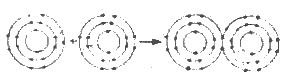
The diagram above represents the formation of
Options:A) a metallic bond
B) an electrovalent bond
C) a covalent bond
D) a coordinate covalent bond
Show Answer
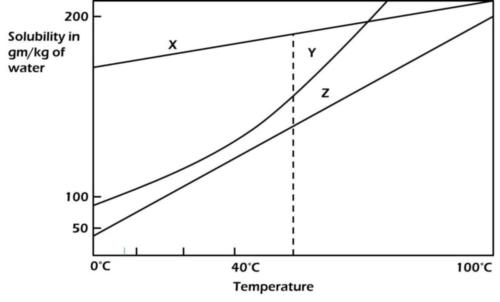
Consider the solubility curves of three salts X, Y and Z given in the diagram. If each solution of the salt contains 200 g, and is heated to 100°C, which solution or solutions will deposit 100 g of the solute when suddenly cooled to 0°C?
Options:A) X only
B) Y only
C) Z only
D) X and Z
E) Y and Z
Show Answer