A) Distillation
B) Condensation
C) Extraction
D) Evaporation
Show Answer
The correct answer is A .
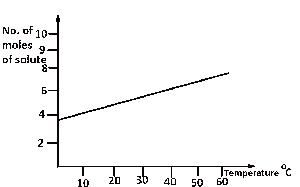
From the diagram above, find the amount of solute deposited when 200 cm3 of the solution is cooled from 55oC to 40oC
Options:A) 0.10 mole
B) 0.20mole
C) 0.01 mole
D) 0.02 mole
Show Answer
The correct answer is B .
A) producer gas
B) natural gas
C) synthetic gas
D) industrial gas
Show Answer
The correct answer is C .
The Sulphide which is insoluble in dilute hydrochloric acid is
Options:A) FeS
B) CuS
C) ZnS
D) Na2S
Show Answer
The correct answer is B .
A) butane gas flame
B) acetylene flame
C) kerosene flame
D) oxy-acetylene flame
E) oxygen flame
Show Answer
The correct answer is D .
N
From the reaction above, which of these conditions would produce the highest equilibrium yield forN
A) Low temperature and high pressure
B) Low temperature and low pressure
C) high temperature and low pressure
D) high temperature and high pressure
Show Answer
The correct answer is A .
At 2.0 atm pressure, the volume of a gas is 4.0 L. If the pressure is reduced to 1.0 atm while keeping the temperature constant, what will be the new volume of the gas?
Options:A) 2.0 L
B) 6.0 L
C) 8.0 L
D) 4.0 L
Show Answer
The correct answer is C .
A) lead
B) zinc
C) aluminium
D) copper
Show Answer
The correct answer is D .
A) principal
B) Arzimuthal
C) Magnetic
D) Spin
Show Answer
The correct answer is B .
The scientist who stated that matter can be converted into energy is?
Options:A) Boyle
B) Lavoiser
C) Avogadro
D) Einstein
Show Answer
The correct answer is D .