A) Copper
B) Iron
C) Lead
D) Mercury
Show Answer
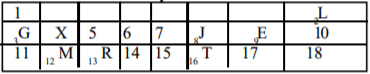
Use the section of the periodic table above to answer this question.
Which letter represents a non-metal that is a solid at room temperature?
Options:A) T
B) R
C) J
D) X
Show Answer
The electronic configuration of element Z is 1s
A) Z
B) ZSO
C) Z
D) Z
Show Answer
Consider the equation below:
Cr
The oxidation number of chromium changes from
Options:A) +5 to +3
B) +6 to +3
C) -2 to +3
D) +7 to +3
Show Answer
A) evolves a lot of heat when burnt
B) combines explosively with oxygen
C) is a very light gas
D) is a rocket fuel
Show Answer
200cm
A) 10g
B) 25g
C) 20g
D) 15g
Show Answer
The IUPAC nomenclature of the compound
H
A) 3,4- dimethylhexane
B) 2,3- dimethyl pentane
C) 2- ethyl hexane
D) 2,3- dimethylhexane
Show Answer
Which of the following is the electronic configuration of sodium?
(Atomic number of Na = 11)
Options:A) 1s2 2s22p6 3s2
B) 1s2 2s22p6 3s2 3p1s2 2s22p6 3s1
C) 1s2 2s22p6 3s1
D) 1s2 2s22p6 3s°
E) 1s2 2s22p6 4s1
Show Answer
A) Undissolved solute and the solvent
B) Dissolved solute and the solvent
C) Dissolved solute and the undissolved solute
D) Dissolved solute and the solution
Show Answer
An unknown organic compound X has a relative molecular mass of 180. It is a colourless crystaline solid, readily soluble in water. X contains the elements C, H and O in the atomic ratio 1: 2:1. The compound has a sweet teste and melts on heating. In the presence of yeast and in the absence of air, X is converted to compound Y and a colourless gas. Compound Y reacts with sodium metal to produce a gas Z which gives a 'pop' sound with a glowing splint. Y also reacts with ethanoic acid to give a sweet smelling compound W.
The molecular formula of X is
Options:A) C12H22O11
B) C6H12O6
C) C3H6O 3
D) C7H14O7
E) C12H6O4
Show Answer