A) an increase in price leads to an increase in quantity demanded
B) an increase in price leaves the quantity demanded unchanged
C) a decrease in price leads to a decreased in quantity demanded
D) a decrease in price leads to an increase in quantity demanded
E) supplies respond by offering less commodities for sale
Show Answer
The correct answer is D .
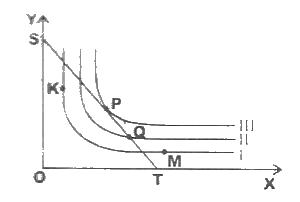
A movement from K to M will
Options:A) decrease the consumer's utility
B) increase the price of the commodity
C) increase the consumer's utility
D) leave consumer's utility unchanged
Show Answer
The correct answer is D .
A) different buyers pay different prices for the same product
B) different products are sold to the same buyer
C) sellers determine whom to sell their products to
D) the same product is available in different forms
Show Answer
The correct answer is D .
A) N4
B) N8
C) N2
D) N10
Show Answer
The correct answer is A .
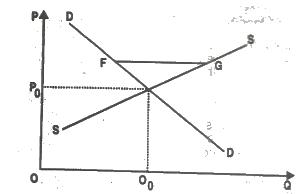
Which of the following is NOT a visible iterm in international trade payments?`
Options:A) Payments for imported cars
B) Receipts from coca exports
C) Payments to foreign shipping companies
D) Payments for steel imports
E) Payments for petroleum imports
Show Answer
The correct answer is C .
A) zero
B) 1
C) 2
D) 5
E) 10
Show Answer
The correct answer is C .
| X | Y | Z | |||
| Price (₦) | Quantity (Units) | Price (₦) | Quantity (Units) | Price (₦) | Quantity (₦) |
| 0 | 20 | 0 | 15 | 0 | 40 |
| 2 | 15 | 2 | 10 | 2 | 30 |
| 5 | 10 | 5 | 5 | 5 | 15 |
| 10 | 0 | 10 | 2 | 10 | 5 |
Use the following information above to answer this question. X, Y and Z are the only three consumers of a commodity. Their respective demand schedules for the commodity are as given above. What is market demand for the commodity when price is N5?
Options:A) 65 units
B) 40 units
C) 30 units
D) 20 units
Show Answer
The correct answer is C .
A) imports of the country exceeding its exports
B) overall deficit or surplus in the current account and capital account of the balance of payment
C) capital flowing out of the country exceeds the capital flowing into the country
D) deficit in the trade balance
E) export earnings exceeds cost of imports
Show Answer
The correct answer is B .
External economies arises essentially from__________
Options:A) a firm's individual policies
B) localisation of industry
C) government economic policy
D) free transferability of shares
Show Answer
The correct answer is B .
A) Risk
B) Scarcity
C) Opportunity cost
D) Allocative efficiency
Show Answer
The correct answer is A .