The lands that belong to the community is referred to as__________
Options:A) sacred land
B) individual land
C) communal land
D) rent land
Show Answer
The correct answer is C .
A) huge volume of petroleum activities in the country
B) diversification system of economic activities
C) high demand for foreign commodities
D) high rate of unemployment
Show Answer
The correct answer is A .
Part-time workers who desire full-time employment are:
Options:A) Underemployed and contribute to the unemployment statistic
B) Underemployed but do not contribute to the unemployment statistic
C) Not part of the labour force and do not contribute to the unemployment statistic
D) Cyclical unemployment
Show Answer
The correct answer is B .
A country has a population distribution as shown below:
The dependency ratio is
Options:A) 3:2
B) 1:3
C) 2:3
D) 1:5
Show Answer
The correct answer is D .
A) sole proprietorship
B) partnership
C) joint stock company
D) co-operative society
Show Answer
The correct answer is C .
A) two to twenty persons
B) minimum of two and maximum of fifty
C) minimum of seven and no maximum number
D) owner owned by the government
Show Answer
The correct answer is C .
A) usefulness
B) power of satisfying a want
C) beneficial
D) advantageous
E) consumable
Show Answer
The correct answer is B .
A) Exchange rate
B) Fiscal policy
C) Risk associated with the loan
D) Rate of production in the country
Show Answer
The correct answer is C .
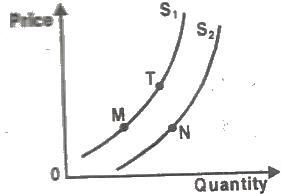
When there is a change from T to N, it implies that
Options:A) Supply has increased
B) Quantity supplied has increased
C) Quantity demanded has increased
D) Price has fallen
Show Answer
The correct answer is A .
A) oligopoly
B) perfect competition
C) monopoly
D) monopolistic competition
E) imperfect competititon
Show Answer
The correct answer is A .