
Use the above graph above to answer this question . CH3-C = CH
A) A
B) B
C) C
D) D
Show Answer
The correct answer is B .
A) The mass of a proton is 1840 times the mass of electron
B) the total mass of the protons in a particular nucleus is always half the nuclear size
C) The mass of a proton is one - twelfth the molar mass of carbon
D) The mass of a proton is 1.0008g
Show Answer
The correct answer is D .
A) Chlorine
B) Sulphur (IV) oxide
C) Ammonia
D) Carbon (IV) oxide
Show Answer
The correct answer is C .
Give the common name for the following compound (CH
A) Isobutyl bromide
B) Methyl bromide
C) propyl bromide
D) Butyl bromide
Show Answer
The correct answer is A .
A) CH3C = CH
B) CH3CH = CH2
C) CH3CH2C = CH
D) CH33CH2CH3
Show Answer
The correct answer is A .
A) Substitution
B) Polymerization
C) Addition
D) Saponification
E) Oxidation
Show Answer
The correct answer is C .
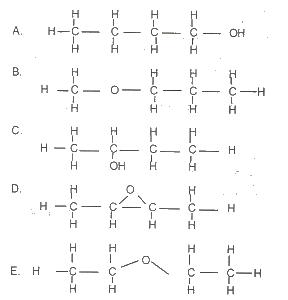
Use the diagram above to answer this question.
Which of the following structural formula is NOT isomeric with the others?
Options:A) A
B) B
C) C
D) D
E) E
Show Answer
The correct answer is D .
A) bromine water
B) Fehling’s solution
C) sodium hydrogen trioxocarbonate (iv)
D) Ammoniacal silver trioxonitrate(V)
Show Answer
The correct answer is C .
In order to electroplate spoon with silver, the arrangement of the electrolytic cell is?
Options:A) the anode is a silver rod and the cathode is the spoon
B) the anode is the spoon and the cathode is a silver rod
C) the electrolyte is silver trioxonitrate(v)( solution and the cathode is a silver rod.
D) the electrolyte is silver trioxonitrate(v) solution and the anode is the spoon
Show Answer
The correct answer is A .
An element Z contains 80% of
A) 16.2
B) 17.6
C) 16.0
D) 16.4
Show Answer
The correct answer is D .