A) positive change
B) negative entropy change
C) no entropy change
D) a minimum entropy change
Show Answer
The correct answer is C .
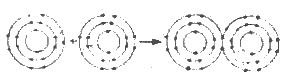
The diagram above represents the formation of
Options:A) a metallic bond
B) an electrovalent bond
C) a covalent bond
D) a coordinate covalent bond
Show Answer
The correct answer is C .
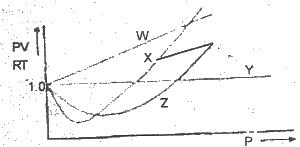
Which of the curves in the above graph illustrates the behaviour of an ideal gas?
Options:A) W
B) X
C) Y
D) Z
Show Answer
The correct answer is C .
What type of reaction is involved in the formation of alkanols from alkenes?
Options:A) Elimination reaction
B) Redox reaction
C) Substitution reaction
D) Addition reaction
Show Answer
The correct answer is D .
Identify the reducing agent in the following reaction:
Zn + CuSO
A) Cu
B) Zn
C) ZnSO
D) CuSO
Show Answer
The correct answer is B .
A) -3
B) +3
C) -6
D) +6
Show Answer
The correct answer is B .
Which of the following substances is NOT hygroscopic?
Options:A) Salt
B) Sugar
C) Silica gel
D) Aluminum
Show Answer
The correct answer is D .

Choose the correct answer from the options above.
When Fehling's solution is added to two isomeric carbonyl compounds X and Y with the molecular formula C 5H 10O, compound X gives a red precipitate while Y does not react. It can be inferred that X is
Options:A) A
B) B
C) C
D) D
Show Answer
The correct answer is B .
A) C5H12
B) C4H6
C) CH3COOH
D) C2H5OH
Show Answer
The correct answer is D .
In troposphere, the two types of pollutants are?
Options:A) Gaseous and particulate pollutants
B) Carbon and metallic pollutants
C) Natural and man-made pollutants
D) Sulphuric and nitrogenous pollutants
Show Answer
The correct answer is A .