A) platinum
B) copper
C) zinc
D) carbon
Show Answer
The correct answer is D .
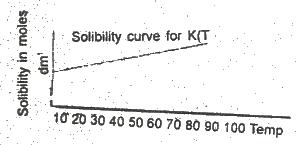
If in the graph above 1 dm3 of a saturated solution of KCL is cooled from 80oC, the mass of crystals deposited will be [K = 39, Cl = 35.5]
Options:A) 7.45 g
B) 14.90 g
C) 74.50 g
D) 149.00 g
Show Answer
The correct answer is D .
A) Red
B) Yellow
C) Pink
D) Blue
Show Answer
The correct answer is D .
A) 1
B) 3
C) 5
D) 7
Show Answer
The correct answer is D .
A) 54.0g
B) 27.0g
C) 13.5g
D) 108.0g
Show Answer
The correct answer is A .
A) negative
B) zero
C) positive
D) indeterminate
Show Answer
The correct answer is D .
A) 0.20
B) 0.30
C) 0.40
D) 0.50
Show Answer
The correct answer is C .
An element having the atomic number 17 will resemble which of the following elements having atomic number as given below?
Options:A) 33
B) 35
C) 18
D) 19
Show Answer
The correct answer is B .
2H2S(g) + SO2(g) + H2O(l) → 3S(s) + 3H2O(l)..........(I)
3CuO(s) + 2NH3(g) → 3Cu(s) + 3H2O(l) + N2(g).........(II)
In the equations above, the oxidizing agent (I) and the reducing agent in (II) respectively are?
Options:A) H2S and NH3
B) SO2 and CuO
C) SO2 and NH3
D) H2S and CuO
Show Answer
The correct answer is C .
A) Lead
B) Magnesium
C) Cpper
D) Gold
Show Answer
The correct answer is B .