A) heart, arteries, capillaries and veins
B) heart, aorta, capillaries and veins
C) heart, aorta, arteries and veins
D) heart, vena cava, arteries, and veins
Show Answer
The correct answer is A .
A) All their sons will be haemophlic
B) all their daughters will be haemophilic
C) All their daughters will be carriers
D) all their sons will be carriers
Show Answer
The correct answer is C .
Viviparity refers to the reproductive strategy in which
Options:A) Offspring are produced by internal fertilization
B) Offspring are produced by external fertilization
C) Offspring develop and are nourished inside the female's body
D) Offspring develop and are nourished outside the female's body
Show Answer
The correct answer is C .
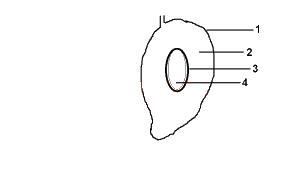
The figure above is a section of a drupe. The part numbered 2 is
Options:A) epicarp
B) endocarp
C) mesocarp
D) seed
E) pericarp
Show Answer
The correct answer is C .
A) show alternation of generations
B) reproduce sexually by conjugation
C) produce spores that are dispersed
D) possess chlorophyll in their tissues
Show Answer
The correct answer is C .
A) snail
B) Taenia
C) Schistosoma
D) Earth worm
Show Answer
The correct answer is C .
In which of the following does external fertilization take place?
Options:A) toad
B) lizard
C) bird
D) cockroach
Show Answer
The correct answer is A .
A) amphibians
B) pisces
C) repitles
D) aves
Show Answer
The correct answer is D .

The correct evolutionary sequence of the organisms represented is
Options:A) IV->II->III->I
B) III->II->I->IV
C) II->III->IV->I
D) I->III=>II->IV
Show Answer
The correct answer is A .
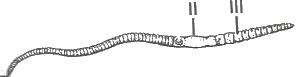
The organism is found in soils rich in
Options:A) mud
B) humus
C) clay
D) sand
Show Answer
The correct answer is B .