A) exhibits bilateral symmentry
B) are triploblastic
C) are metamerically segmented
D) possess complete digestive system
Show Answer
The correct answer is C .
A) Contractile vacuole
B) Flame cell
C) Malpighian tubule
D) Nephridium
Show Answer
The correct answer is D .
A) cambium
B) xylem
C) cortex
D) phloem
Show Answer
The correct answer is B .
A) Albinism
B) Baldness
C) Haemophilia
D) Colour blindness
Show Answer
The correct answer is A .
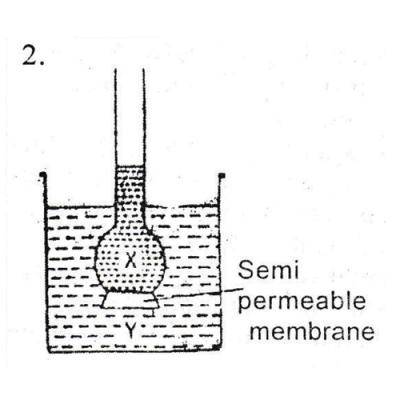
What would happen if solution Y is more concentrated than solution X in fig 2?
Options:A) The level of X would rise, Y would falls
B) The level of X would rise, Y would rise
C) The level of X and Y stands the same
D) The level of Y would rise, X would fall.
Show Answer
The correct answer is D .
A) thick skin
B) pentadactyl limb
C) tail
D) epidermal structure
Show Answer
The correct answer is B .
A) spleen
B) pancreas
C) liver
D) gall bladder
Show Answer
The correct answer is B .
A) bryop
B) fungi
C) algae
D) gymnosperms
Show Answer
The correct answer is B .
A) niche
B) a food chain
C) an ecosystem
D) a mirohabitat
Show Answer
The correct answer is C .
Which gland is responsible for producing the hormone insulin?
Options:A) Thyroid gland
B) Pituitary gland
C) Pancreas
D) Adrenal gland
Show Answer
The correct answer is C .