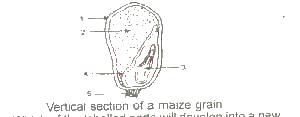
The structure labelled 1 is the
Options:A) plumule
B) radicle
C) cell membrane
D) seed coat
Show Answer
The correct answer is D .

The structure labelled 5 is the
Options:A) sweat gland
B) sebaceous gland
C) blood vessel
D) nerve fibre
Show Answer
The correct answer is A .
A) reproductive organs are not involved
B) new individuals are not formed
C) many new plants are produced
D) there is no exchange of genetic materials
Show Answer
The correct answer is D .
A) Chlamydomonas and Euglena
B) Planeria and Amoeba
C) Amoeba and Hydra
D) Paramecium and Planeria
Show Answer
The correct answer is A .
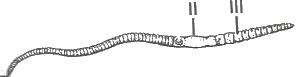
The organism is found in soils rich in
Options:A) mud
B) humus
C) clay
D) sand
Show Answer
The correct answer is B .
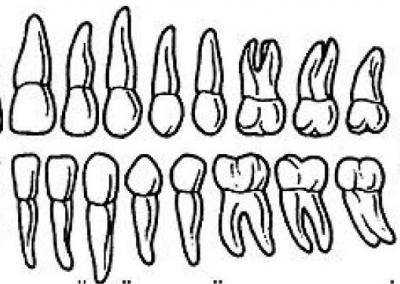
Use the diagram to answer the question that follows:
The structure is adapted for
Options:A) omnivores
B) herbivores
C) canivores
D) omnivores and canivore
Show Answer
The correct answer is A .
Examples of micronutrients include the following except
Options:A) vitamins A
B) Vitamin B6
C) Biotin
D) carbon
Show Answer
The correct answer is D .
Which of the following is an example of an abiotic ecological factor?
Options:A) Temperature
B) Competition
C) Predation
D) Symbiosis
Show Answer
The correct answer is A .
A) leaves
B) stems
C) roots
D) buds
Show Answer
The correct answer is B .
A) show alternation of generations
B) reproduce sexually by conjugation
C) produce spores that are dispersed
D) possess chlorophyll in their tissues
Show Answer
The correct answer is C .